/projects/pampa-devs
← All projectsPampa Devs
My studio’s site, and the tool it sends proposals with.
Founder — design & implementation · 2020–2021, 2025 – Current
Overview
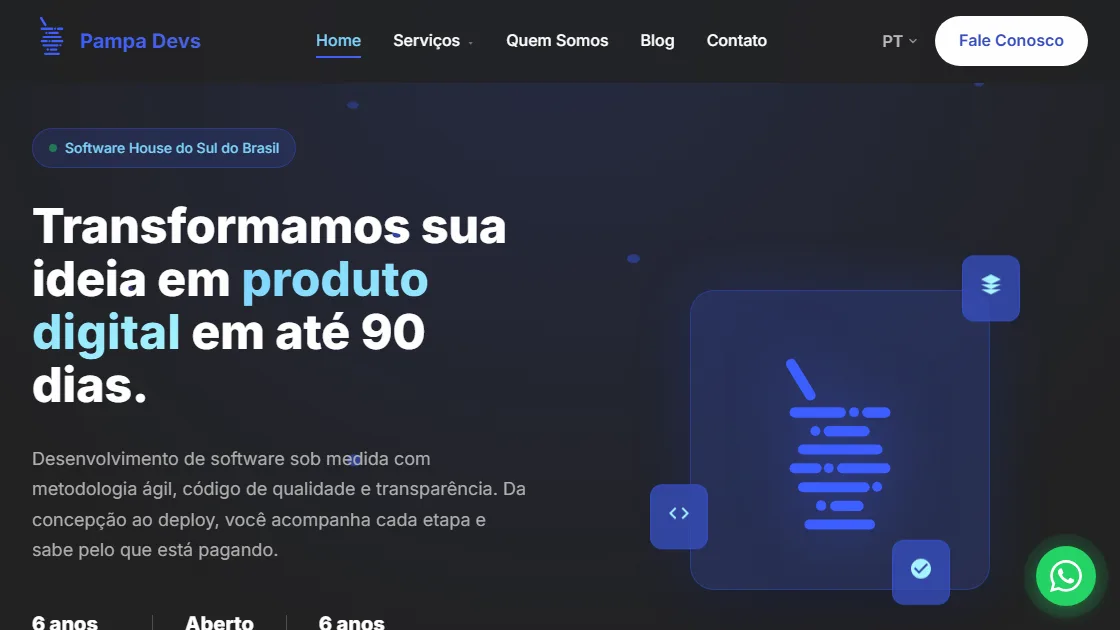
Pampa Devs is my software studio, and this is where a prospective client meets it. The site carries the service catalogue, a blog in two languages, and three landing pages aimed at particular services. Two parts of it are not what a studio site usually does: the services are demonstrated by working versions of themselves rather than by screenshots, and a commercial proposal is rendered as a page here instead of attached to an email.
What I did
I built it and I keep it running — about two thirds of the commits, across two stretches: the first version in 2020–2021, and the work that resumed in 2025.
- The site itself: the catalogue, the landing pages, the blog and the two locales it all renders in.
- The embedded demos — the storefront, the chat assistant, the checkout and the lead form.
- The proposal renderer: diagnosis, strategy, timeline, cost, return and architecture as sections of a page.
Two engineers from the studio worked on it with me; roughly a third of the commits are theirs.
The problem
A studio selling websites, online stores and automations to small businesses has to show that it can build them, to people who do not read code. Screenshots of past work prove less than they look like they do — the reader cannot tell what is a real product and what is a mockup made for the pitch.
What it does
- A storefront demo you can actually use: pick a size, add to the cart, watch the total change.
- A chat assistant demo that answers, and a lead form that walks through to its confirmation.
- A blog with posts written in both languages, not one language machine-translated into the other.
- Client proposals as pages: diagnosis, strategy, timeline, cost, return, before and after, architecture.
Engineering decisions
Demonstrating the services instead of describing them
The storefront, the chat assistant and the checkout on the services page are working front ends, not images. Someone deciding whether to buy an online store can put something in a cart before deciding. It costs more to build than a screenshot, and it is the part of the site that does the selling.
A proposal is a page, not a document
A commercial proposal is a view on this site, assembled from the same sections every time: the diagnosis, the strategy, how the work runs, the timeline, the cost, the expected return, a before and after, the architecture, and the questions clients ask. The client opens a link. Changing the offer means changing a page, not re-exporting a file and hoping the right version was attached.
Static, and deployed as static
There is no server behind it. The blog posts are files in the repository, the demos run in the browser, and the whole thing is published as a static site with a rewrite rule for client-side routing. A marketing site that goes down because a backend went down is a cost with no matching benefit.